






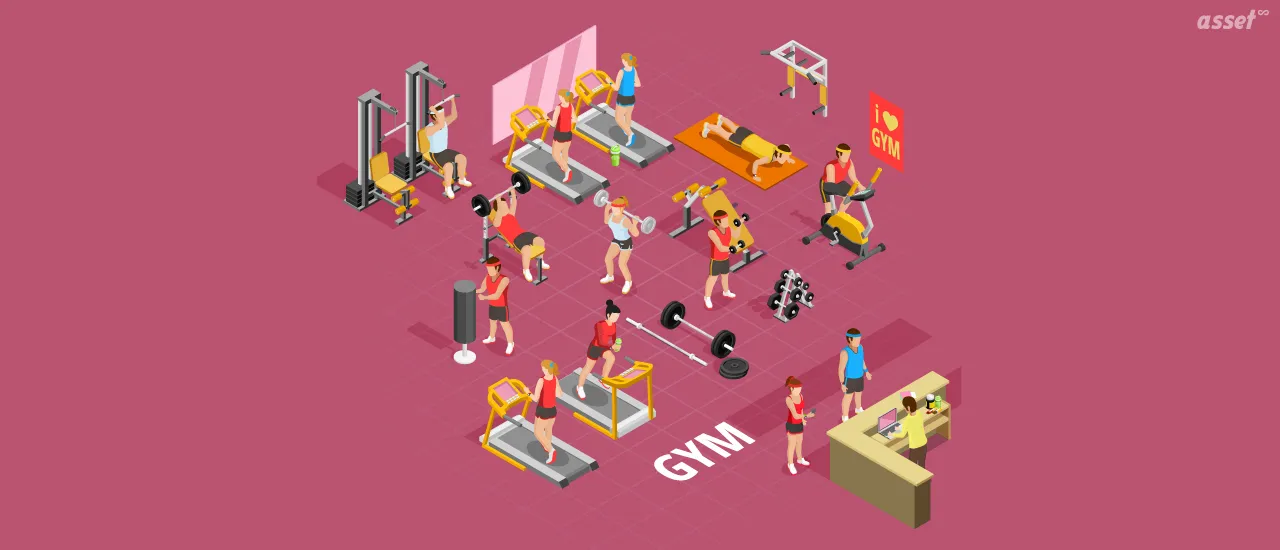
Today’s generation is far from lazy. People might not play sports as much because of busy schedules, but they put their health first and work out hard to stay in shape.
The goal is to stay fit and healthy as much as to lose weight, and people go to gyms and fitness chains to work out and look after their health.
People give a lot of business to gyms and fitness chains because they offer a convenient place with organized workout equipment and other benefits, such as trainers, health drinks and snacks, and membership discounts.
What Assets and Equipment Do Gym and Fitness Chains Use?
Gym and fitness chains depend heavily on the assets and equipment that members use to exercise.
Gym equipment is any device used for physical activity to build strength and improve the effect of exercise.
Some popular and common pieces of gym equipment are:
- Treadmills
- Dumbbells
- Kettlebells
- Metal Plates
- Stationary Bikes
- Chest Press Machines
- Chest Fly Machines
- Shoulder Press Machines
- Lat Pull Down Machines
- Cable Row Machines
- Biceps Curl Benches
- Leg Press Machines
- Leg Extension Machines
- Abdominal Crunch Machines
- Power Racks
- Smith Machines, and many more.
How Do Gym and Fitness Chains Work?
A gym is a place, often a large room, equipped with a range of facilities that help people improve and maintain their physical fitness, health, and strength.
Running a gym smoothly is an ongoing process with several important procedures. The most important part of gym equipment management, and one of the main responsibilities of the owner or manager, is maintaining the exercise equipment.
Good preventive maintenance of gym equipment makes gyms and fitness chains safer and more productive and builds a healthy environment for members.
Note: The health club market has grown steadily for years, and every member counts. Each piece of broken equipment is a member who can’t train the way they want to.
Modern Asset Management Software for Gym and Fitness Chains
1. Simple and Smart Software
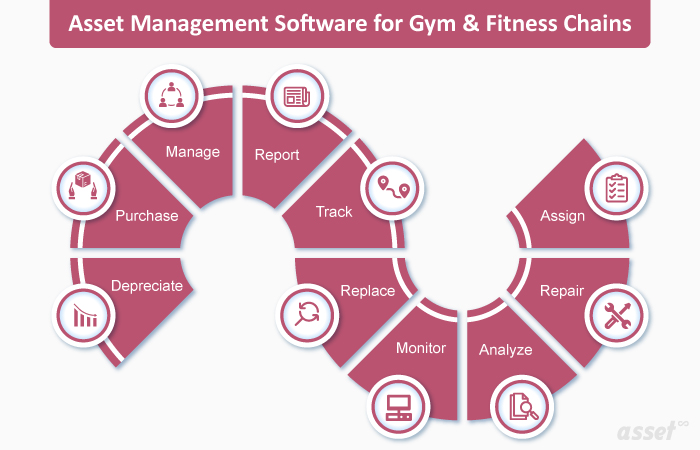
Gym and fitness chain owners and managers should adopt simple, smart asset tracking software that helps them in the simplest way possible.
Its features should include the ability to:
- Track
- Replace
- Monitor
- Manage
- Report
- Analyze
- Depreciate
2. Easy to Use
Nobody likes software that is hard to understand, so the software should be easy to use.
3. Customizable
For effective workflows and daily operations, the software must be tailored to your specific requirements.
4. Quick Updates with Cloud-Based Software
Many businesses now work in the cloud to keep their data secure and save time, and they get regular software updates and up-to-date information about work.
You can use the application’s features whenever and wherever you want, with just an internet connection.
5. Reduce Maintenance Expenses
Once your data is in the software, it sends notifications and alerts for the repair and maintenance of assets and equipment, which reduces costs for gym and fitness chain owners.
6. Higher Productivity
When assets and equipment are managed through the software, they perform better and are down less often, which increases the overall productivity of gym and fitness chains.
7. Smart Sync with the Mobile World
Modern software comes with mobile apps for a better user experience, and asset management software does too.
That means you can use the software’s features on your phone as well.
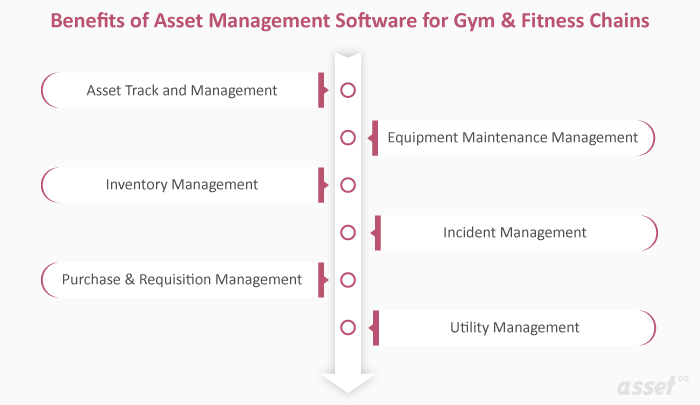
How Is Asset Management Software Beneficial for Gym and Fitness Chains?
1. Asset Tracking and Management
Asset management software helps you track and manage your high-value assets and equipment. It keeps their records current and plays an important role in extending the life of an asset.
Features of asset tracking and management include:
- Asset Tagging
- Asset Audits
- Check-in/Check-out
- Asset Recovery
- User Restrictions
- Asset Tracking
- Reporting
- Support
- Security
2. Inventory Management
Stock on hand is one of the valuable assets of any gym and fitness chain. A large stock carries risks of spoilage, theft, damage, and shifts in demand, so inventory must be insured, or else sold off at clearance prices or discarded if it doesn’t sell.
Inventory management is important for a business of any size, because it tells you:
- When to restock certain items
- How much to purchase
- What price to pay
- When to sell
- At what price to sell
- How to plan and control inventory
- How stock is moving
- The reorder level
3. Purchase and Requisition Management
The software lets a business bring every purchase request into a single cloud database, to be monitored and controlled from anywhere, at any time.
Cloud-based purchase requisition management removes most of the paperwork and reduces manual work and human error, with transparency and lower operating costs throughout the cycle. The software improves accuracy, execution, and process efficiency.
The key features include:
- Requests go through an approval chain set by their value before an order is placed.
- Supplier invoices can be matched against the purchase order and what was received.
- Records are stored centrally, so requests are easy to find and approve.
- Purchasing information is kept secure with user-specific permissions.
- Automated notifications and reminders prompt the people involved to act on time.
4. Equipment Maintenance Management
The main aim of equipment maintenance is to maintain the functionality of the equipment and minimize breakdowns.
For mechanical equipment, maintenance management involves repairing, replacing, and servicing tools. It keeps equipment working properly and catches irregularities as they occur.
- Machine performance: With long working hours, preventive maintenance keeps equipment performing well and preserves its life expectancy.
- Detection of potential issues: Equipment keeps working under safe conditions, for both the equipment and the member. Potential issues can be detected in advance and fixed before they cause physical or financial harm.
- Time saving: Planned maintenance takes far less time than the downtime caused by malfunctioning equipment and unexpected repairs.
- Money saving: Unexpected breakdowns cost a lot of money and reduce productivity, so preventive maintenance saves you money overall.
5. Incident Management
The aim of incident management is to restore normal service as soon as possible and minimize the effect on your gym operations, protecting the quality and availability of the service.
The benefits of incident management for gym and fitness chain owners and managers are:
- Service quality is maintained
- Room for improvement is identified
- Service management is documented
- Users are satisfied
6. Utility Management
Energy management software helps companies manage, monitor, and analyze consumption, and report on it. It also helps calculate costs by year, month, or day and allocate them internally.
A big advantage of the software is that it flags consumption that is higher than expected, so you know when usage has gone beyond what it should be.
Systems often covered by utility monitoring and management include:
- HVAC systems
- Electrical operations
- Tenant overrides
- Elevators
- Video surveillance systems
- ID and card management systems
- Security and alarm systems
Also Read: Key Features to Look for While Choosing Asset Management Software
Well-Managed Equipment Keeps Members Coming Back
Gym membership has grown over the years, and members expect equipment that works every time they visit.
That makes asset management software a very important part of running gyms and fitness chains. As discussed above, it has many benefits for both members and owners, which is why it has become essential.