






A natural disaster can occur anytime, anywhere in the world, and most of the time it cannot be prevented. Disasters can damage human lives, transport, property and more.
Besides natural disasters, there are man-made disasters, which can be even more harmful to people.
Man-made disasters can even shut an organization down permanently, because they usually start inside an organization. That is why every organization needs an emergency plan.
Disaster management within asset management exists for one purpose: to avoid a crisis. It is the organization’s responsibility to be prepared, so that if a natural disaster occurs, the impact is kept as small as possible.
Asset tracking and management software helps in many ways, such as tracking and managing all resources and staff effectively and quickly.
Also Read: How to Get a Better Hold on Your Asset Management Process
What Are the Different Types of Disasters?
There are two main categories of disaster:
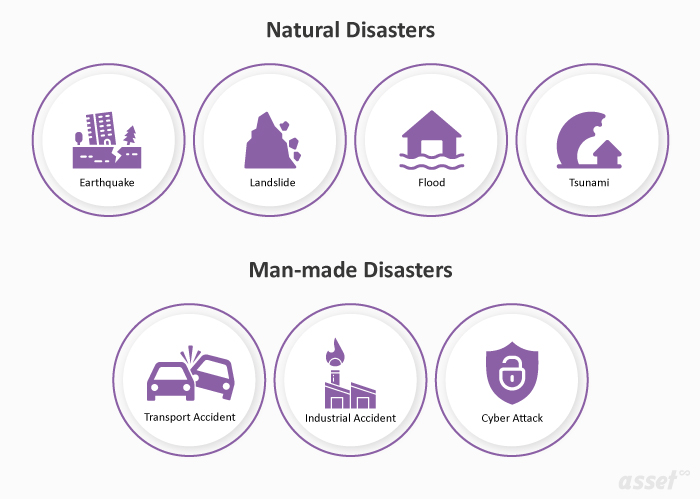
1. Natural Disaster
Mother Nature can be ruthless, and it is so powerful that humans cannot control it. You cannot stop a natural disaster; you can only prepare for it. We all take precautions to secure our homes, but we cannot always say the same about our offices.
Many small business owners still do not have a plan for disaster preparation and recovery.
2. Man-Made Disaster
Man-made disasters can cause more havoc than natural disasters. They mostly occur within firms and organizations, so they affect workers’ lives in the long run.
Think of the Chernobyl disaster, whose impact can still be seen today. 31 people died as an immediate result when the disaster occurred.
According to a United Nations press release, “A total of up to 4,000 people could eventually die of radiation exposure from the Chernobyl nuclear power plant (NPP) accident nearly 20 years ago, an international team of more than 100 scientists has concluded.”
Natural disasters cannot be controlled, while the effects of man-made disasters on human lives can last for a very long time.
However, man-made disasters can be controlled if the right actions and precautions are taken in time.
How Can Asset Management Help Avoid All Types of Disaster?
Asset management can help organizations avoid disasters, especially man-made ones, in the following ways:
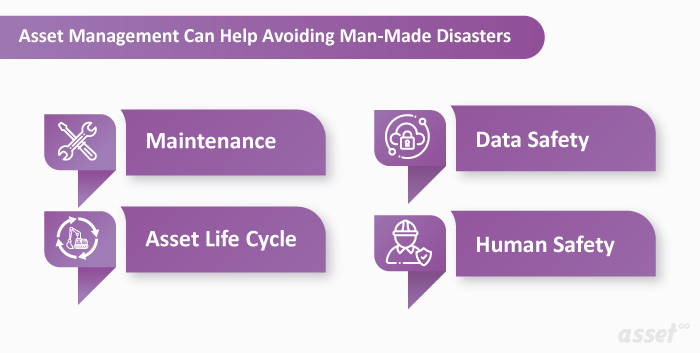
Asset Maintenance
Machines and equipment must be maintained from time to time so they keep running in good condition. This is especially true of machines that are very sensitive to maintenance, such as reactors and heavy equipment.
If maintenance is not done on time, equipment can cause chemical spills or power failures, or release dangerous gases that are very harmful to employees and to the organization.
When an organization has a lot of assets, remembering which ones have been maintained and which have not becomes a daunting task. Asset tracking software lets you keep track of equipment and machines and manage them efficiently.
You can set how often each piece of equipment needs maintenance, such as every 15 days or every month, depending on your requirements. The software then reminds you on that schedule, so you no longer have to keep track by hand.
Asset Life Cycle
Man-made disasters often happen when equipment and machines are not cared for and maintained properly. Another factor is asset life.
Equipment must be disposed of or replaced in time. Otherwise, it can fail and cause catastrophic damage, and other machines and people can suffer collateral damage as well.
With the help of asset tracking software, you can retrieve complete information about each piece of equipment. With this data, you know when you bought it and when it is due for replacement.
Data Safety
Workers and employees are an organization’s assets, but its data and information are among its biggest assets too. During a disaster, all of that data needs to stay safe and sound.
Cloud-based asset tracking software stores data on online servers. In simple terms, even if your own computer is damaged, the data stays safe online.
Not every man-made disaster harms people physically. Cyberattacks are a major issue that can hurt your business silently. That is why organizations must keep data encrypted, so it cannot be stolen.
Cloud-based asset management technology helps here too, protecting data with several layers of security, so you can worry less about data security.
Human Safety
Road accidents are among the biggest man-made disasters. IoT asset tracking can help, for example by alerting a driver who is talking or texting while driving.
IoT sensors collect data about how vehicles are driven, and that data can be used to understand driver behavior and help prevent accidents.
Preparing for the Disasters You Can Control
Nobody wants a disaster, natural or man-made, but unfortunately they happen. We can only reduce the impact of natural disasters, yet we can control man-made disasters with proper planning and by caring for equipment on time, without negligence. Preventive maintenance software helps you avoid a man-made disaster.
Also Read: EAM vs CMMS: Key Differences and Which One You Need
Frequently Asked Questions (FAQs)
1. Which is considered a lethal natural disaster?
Many people would say a tornado or an earthquake, and these disasters are certainly dangerous. Drought is also among the deadliest natural disasters, because its impact lasts a long time.
2. How does asset tracking work precisely?
For accurate asset tracking, assets are tagged with RFID (radio-frequency identification) tags, barcode labels or NFC (near-field communication) chips, or fitted with GPS (global positioning system) trackers or BLE (Bluetooth low energy) tags. These tags are attached to each asset so it can be tracked accurately.
3. Which maintenance practice type is most effective?
No single type of maintenance is the most effective everywhere; the most effective type is the one that works in your organization. For disaster management, preventive and predictive maintenance are the most effective, because they avoid the negligence that leads to equipment failure.